
Wholesale2B vs Doba (2026): Which US Dropshipping Platform Is Better?
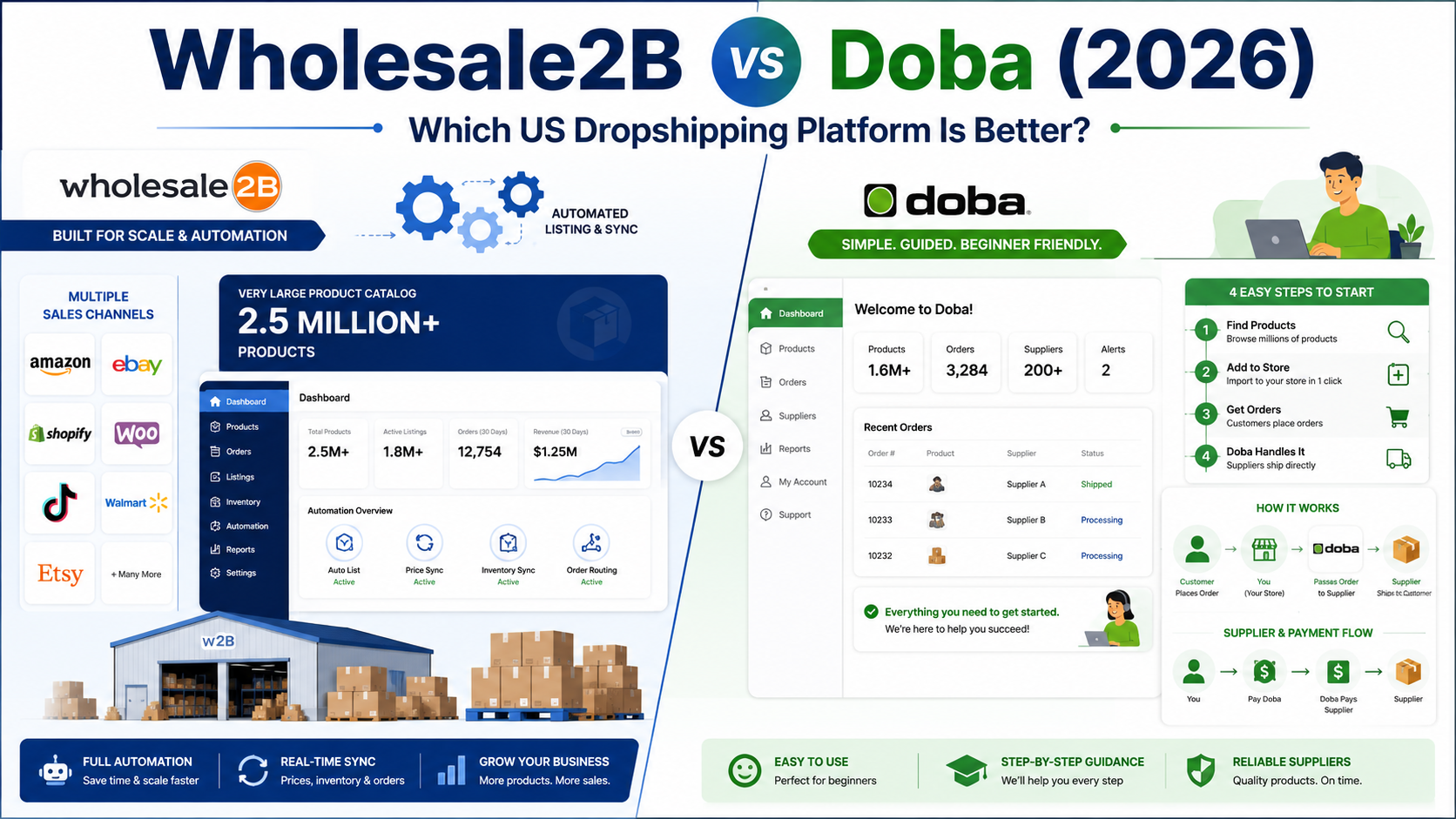
Wholesale2B and Doba are two of the most commonly recommended US dropshipping platforms. They both aggregate vetted suppliers, integrate with Shopify, and give you access to a wide US product catalog without holding inventory.
But they are built for fundamentally different sellers, and picking the wrong one for your operating style will cost you time and frustration.
I have worked with enough stores on both platforms to give you a direct answer on which one fits which situation, instead of the typical “both have pros and cons” non-answer that most comparisons produce.
Why This Comparison Matters
Both platforms are US-oriented, well-established, and used by a wide range of Shopify sellers. That similarity makes the choice feel arbitrary when it is not.
The core difference comes down to one thing: how much control and visibility you want over each individual order.
Doba is built for sellers who want to understand exactly what is happening at every step. Your customer pays you. You go into Doba, pay the supplier, and they ship. That sequence is explicit, manual in the right places, and fully transparent. It is slower, but you always know the status of each order.
Wholesale2B is built for sellers who want to remove themselves from the operational loop as much as possible. You pay Wholesale2B once. They handle supplier communication and fulfillment. Inventory and price sync run automatically. The goal is a store that runs with minimal daily intervention.
Neither model is objectively better. One is right for your current situation and the other is wrong. This comparison will help you figure out which is which.
Catalog Size and Supplier Coverage
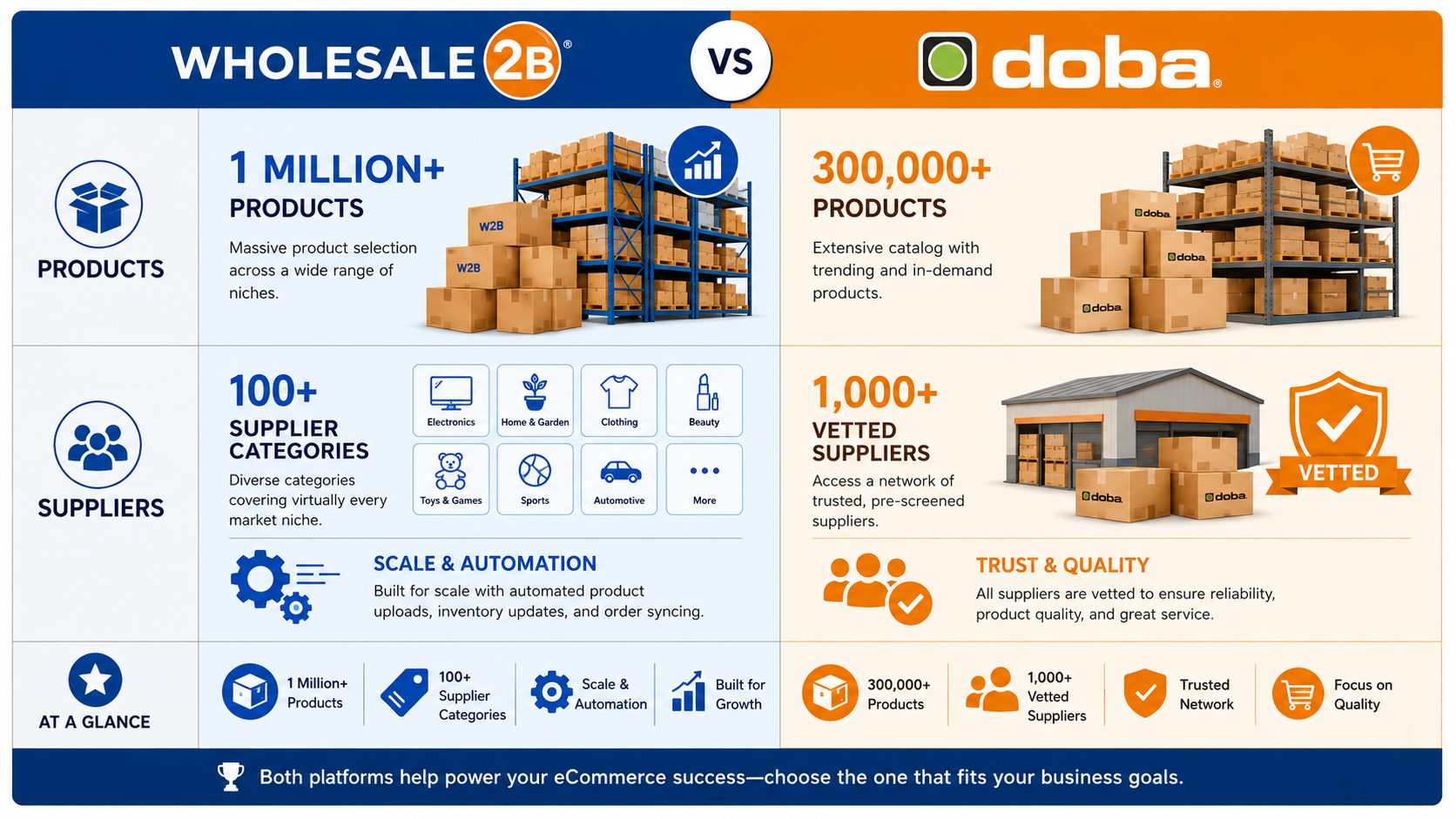
Wholesale2B offers access to over 1 million products from US-based suppliers across more than 100 categories. That is one of the largest catalog sizes in the domestic US dropshipping market. Categories include electronics, apparel, home goods, pet supplies, beauty, and more.
Doba connects over 200,000 plus retailers with 1,000 plus vetted suppliers and access to 300,000 plus products. Smaller catalog than Wholesale2B but the emphasis is on supplier vetting rather than sheer volume. Doba features real-time inventory management and AI-powered product discovery tools for trending product recommendations.
Verdict on catalog: If catalog breadth is your priority, Wholesale2B wins. If you want a platform that actively helps you find trending, high-margin products through built-in discovery tools, Doba has a more useful product research experience.
Automation: Where the Real Difference Lives
This is the most important comparison point for most sellers.
Wholesale2B automation:
- Unified order management: pay Wholesale2B once while they handle supplier communication and fulfillment
- Automated price and stock sync: daily or real-time updates prevent overselling and pricing errors
- Supplier scorecards: review shipping speed and reliability before listing products
- Orders route automatically without per-order manual intervention
Doba automation:
- Real-time inventory and price syncing prevent overselling
- Automated order processing with tracking uploaded to your store
- AI-powered product selection tools and trending product recommendations
- Manual payment step per order: you pay the supplier through Doba after each customer order
The key distinction: Wholesale2B removes you from the individual order payment loop. On Wholesale2B, you have a funded account and orders route without you logging in to pay per transaction.
On Doba, you actively pay the supplier for each order. That is either a feature (full visibility and control) or a friction point (manual step that takes time at scale), depending on how you operate.
If you are fulfilling 50 orders a month, the Doba manual payment step is manageable and gives you clear oversight. If you are fulfilling 500 orders a month, logging in to pay each supplier individually becomes a real operational burden.
Order Workflow: Step by Step
Understanding exactly how each order flows through each platform is practical knowledge that most comparisons skip.
Doba order workflow:
- Customer places an order on your Shopify store
- You receive the order notification
- You log into Doba and locate the order
- You pay the supplier through Doba for that specific order
- The supplier processes the order and ships to your customer
- Tracking is uploaded to your store
Wholesale2B order workflow:
- Customer places an order on your Shopify store
- The order syncs to Wholesale2B automatically
- Wholesale2B processes with the relevant supplier on your behalf
- The supplier ships to your customer
- Tracking syncs back to your Shopify store
Doba’s transparency comes at the cost of extra steps per order. Wholesale2B’s automation comes with less visibility into individual order-level supplier interaction.
For beginners, Doba’s explicit workflow is genuinely educational. You understand exactly how the money flows and where each order is at every moment. For experienced sellers who want to step back from daily order management, Wholesale2B’s automation is the right choice.
Platform Integrations
Both platforms support the major ecommerce channels US sellers use.
Wholesale2B integrations: Shopify, WooCommerce, eBay, Amazon, Magento, Google, Facebook, Weebly. The breadth of integration is one of Wholesale2B’s clear strengths for multi-channel sellers.
Doba integrations: Shopify, eBay, Amazon, Wix, Walmart, BigCommerce, Square, Shift4Shop, WooCommerce.Doba specifically documents Walmart integration, which is useful for sellers targeting the Walmart marketplace alongside their Shopify store.
Verdict on integrations: Both cover the core channels. Doba has Walmart. Wholesale2B has slightly broader breadth including Google and Facebook native integrations. For pure Shopify sellers, both are well-covered.
Pricing and Fee Structure
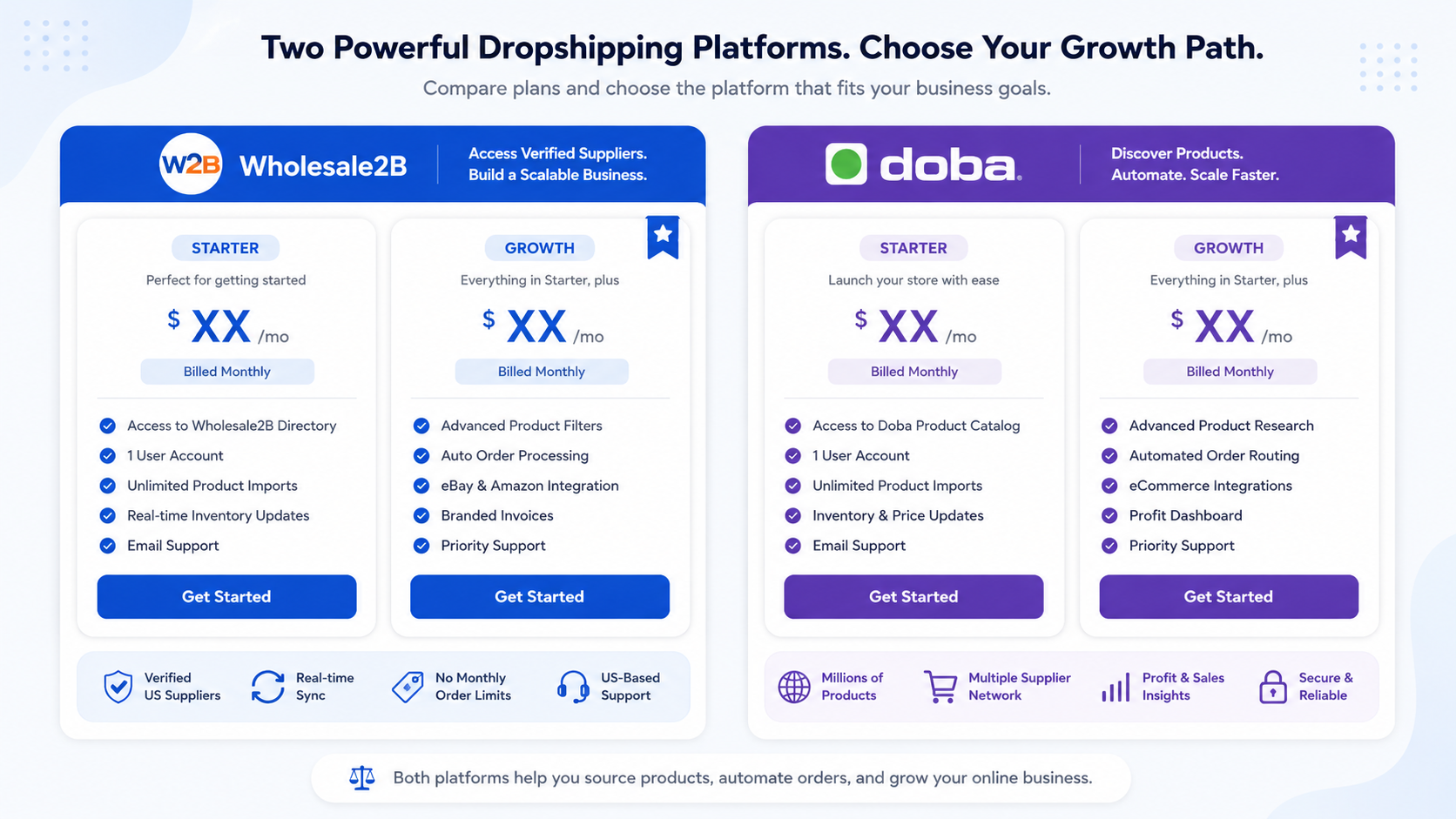
Both platforms use tiered subscription models. Because pricing changes over time, I am not going to publish specific dollar amounts that may be outdated by the time you read this. What I can tell you is the structure and what to watch for.
Wholesale2B pricing structure:
- Multiple plan tiers based on channel (Shopify plan, eBay plan, Amazon plan, etc.)
- Plans are channel-specific, meaning you pay per selling channel you want to integrate
- Free browsing of the catalog without a paid plan
- Paid plan required to activate full integration and order routing
Doba pricing structure:
- Tiered plans based on catalog access and feature level
- Basic plan around $29.99 per month based on documented pricing
- Higher plans unlock more suppliers, more advanced product discovery, and more automation features
Key advice for both: Start on monthly plans while testing. The annual plan discounts are real but the savings are only worth it after you have verified that the platform works reliably for your specific product selection and order volume. Both platforms have billing terms that do not automatically refund annual commitments on downgrade.
Supplier Quality and Returns
Both platforms work with vetted US suppliers, but the vetting approach and the resulting returns experience differ.
Wholesale2B uses supplier scorecards that rate shipping speed and reliability. You can review these scores before listing specific suppliers’ products, which is a practical way to filter for reliable fulfillment before you have personal experience with a supplier.
Doba emphasizes its vetted supplier network with 1,000 plus pre-integrated suppliers. The platform’s product discovery tools also surface suppliers with consistent fulfillment metrics, which is useful for finding reliable sources rather than discovering fulfillment problems after the fact.
For returns, both platforms route returns through the original supplier. Returns policies vary by supplier on both platforms. This is standard across US dropshipping and means you need to check each supplier’s specific policy before listing their products in high-return categories like apparel and electronics.
Who Should Use Wholesale2B
Wholesale2B is the right fit if you match most of these:
- You want the broadest possible US catalog in one place (1 million plus products)
- You want automation that removes you from individual order management
- You are selling across multiple channels (Shopify plus eBay or Amazon or Google)
- You have enough order volume that manual per-order steps would be a real operational burden
- You have previous dropshipping experience and do not need a step-by-step guided workflow
Who Should Use Doba
Doba is the right fit if you match most of these:
- You are starting dropshipping for the first time and want full visibility into every order
- You want the explicit workflow: customer pays you, you pay supplier, supplier ships
- You want AI-powered product discovery tools to help find trending products
- You are targeting Walmart alongside your Shopify store
- You prefer paying per order rather than managing a pre-funded platform account
- You are running lower order volume where per-order manual steps are not a burden
Building Your Store Around Either Platform
Getting your supplier setup right is step one. The store itself is what converts buyers into customers, and both Doba and Wholesale2B sellers fall into the same trap: they invest all their energy in the backend and almost nothing in the frontend.
US buyers judge stores fast. A generic Shopify theme signals a generic dropshipping store. It does not matter whether your supplier is Wholesale2B or Doba.
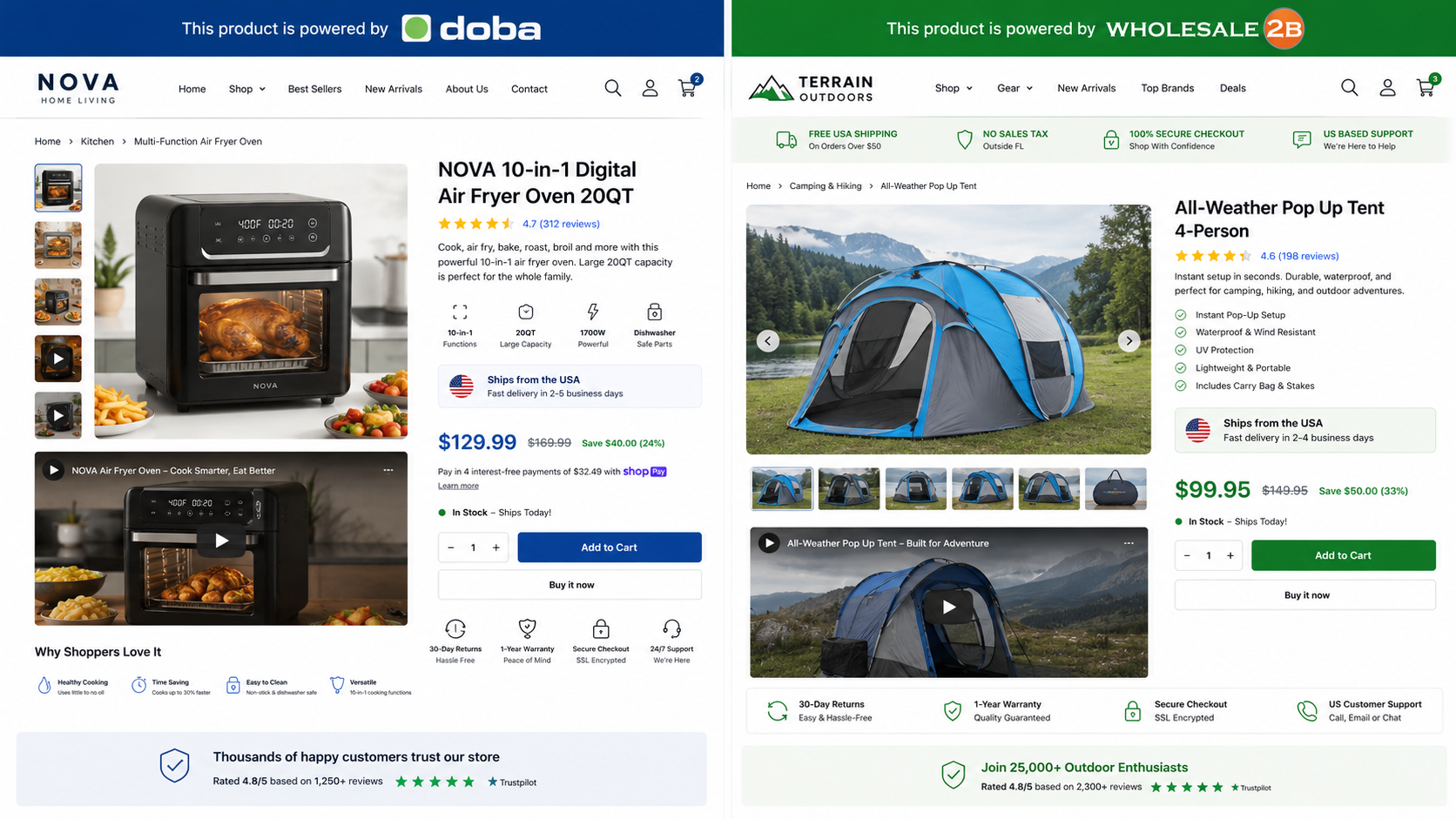
For both platforms, I use Canvify to make the storefront reflect the operating model. A Doba store can lean into curated product education and a controlled launch catalog, while a Wholesale2B store can use stronger category navigation and trust blocks for a broader automated catalog. You design those pages in Canva, then Canvify publishes them as native Shopify pages that load normally and keep the supplier comparison from turning into a generic product grid. Canvify’s template library has starting layouts for Shopify stores across different product categories.
For product pages on either platform, video content is the highest-impact trust signal you can add. If your Doba or Wholesale2B supplier has a product demo on YouTube, paste the link on the product page using EmbedAny. You can also embed TikToks, Instagram posts, Vimeo clips, review widgets, or supplier walkthroughs without iframe work. EmbedAny is listed as a Built for Shopify app, supports 800 plus platforms, and the first few embeds are free, so you can test the effect on a few key products before expanding.
I have seen stores on both platforms improve conversion rates meaningfully just by adding one genuine product video per key product page. US buyers watch videos before buying. Give them something to watch.
EmbedAny also handles review widgets, social proof embeds, and supplier content. For a Wholesale2B or Doba-powered store targeting US buyers who compare carefully before purchasing, that embedded social proof layer helps explain why your store is worth buying from instead of another seller listing the same supplier item.
The Direct Recommendation
If you are starting out and want to understand how US dropshipping actually works before automating it, start with Doba.
If you have done dropshipping before, you understand the order flow, and you want to scale without being tied to daily manual order management, use Wholesale2B.
If you want a verified US-only supplier network with the strongest multi-channel integration including Amazon and Walmart from one account, TopDawg is worth adding to your evaluation.
For the full picture of US supplier options including GreenDropShip for natural and organic niches, the US supplier comparison covers all major platforms.
FAQs
is wholesale2b or doba better for shopify
For pure Shopify sellers who want automation, Wholesale2B is generally the stronger fit because of its automated order routing and unified billing. For beginners who want visibility into each order step, Doba’s guided workflow is more educational. Both integrate well with Shopify.
how much does wholesale2b cost
Wholesale2B uses channel-specific plan tiers. The Shopify integration plan, the eBay plan, and the Amazon plan are priced separately. Check the current pricing page for live rates. Free catalog browsing is available without a paid plan.
how much does doba cost
Doba’s basic plan starts around $29.99 per month based on documented pricing, with higher tiers for more features and supplier access. Check current pricing directly. Annual plans offer a discount but commit you to the platform, so start monthly during testing.
can i use both wholesale2b and doba at the same time
Yes. There is nothing preventing you from subscribing to both and using different suppliers from each platform. Some sellers do this to access suppliers that are on one platform but not the other. The operational complexity of managing two platforms simultaneously is the practical tradeoff.
do wholesale2b and doba both support amazon dropshipping
Yes, both support Amazon integration. Doba specifically calls out Walmart integration as well. Multi-channel selling across Shopify, Amazon, eBay, and Walmart from a single platform is possible with both.
what are the differences in product selection between wholesale2b and doba
Wholesale2B has a larger catalog: over 1 million products across 100 plus categories. Doba has 300,000 plus products from 1,000 plus vetted suppliers with AI-powered product discovery tools for finding trending items. For sheer breadth, Wholesale2B. For trending product research built into the platform, Doba.
which platform has better customer support
Both have documented support channels. User experience reports are mixed for both platforms. Doba gets positive mentions for support response times from some sellers. Wholesale2B’s support is described as functional but not exceptional. Neither platform has the kind of standout support reputation that would make it a primary decision factor.