
8 Ways to Increase Shopify Store Conversion (With Examples)
 Abdullah Shahid
Getting traffic to a Shopify store is hard. Wasting that traffic is easy.
I’ve worked on enough Shopify stores to know the pattern: the problem usually is not that a store has no demand. It’s that the store leaks trust, clarity, and momentum at every step of the funnel.
Someone lands on the homepage. They are mildly interested. They click a product. They hesitate. They add to cart, maybe. Then they disappear.
That is a Shopify conversion problem.
And if I’m being honest, most people try to fix it the wrong way. They obsess over tiny design tweaks before fixing the actual reasons shoppers are not buying.
In this guide, I’ll walk through how I approach Shopify conversion optimization in a practical way: homepage, product pages, trust signals, video, social proof, checkout, urgency, and the tools I use to improve conversion without cluttering the store.
Why Your Shopify Store Is Not Converting (And What Most People Get Wrong)
When a Shopify store is not converting, I don’t start by asking, “What color should the CTA button be?”
I start by asking, “Where is confidence breaking?”
That is the real issue.
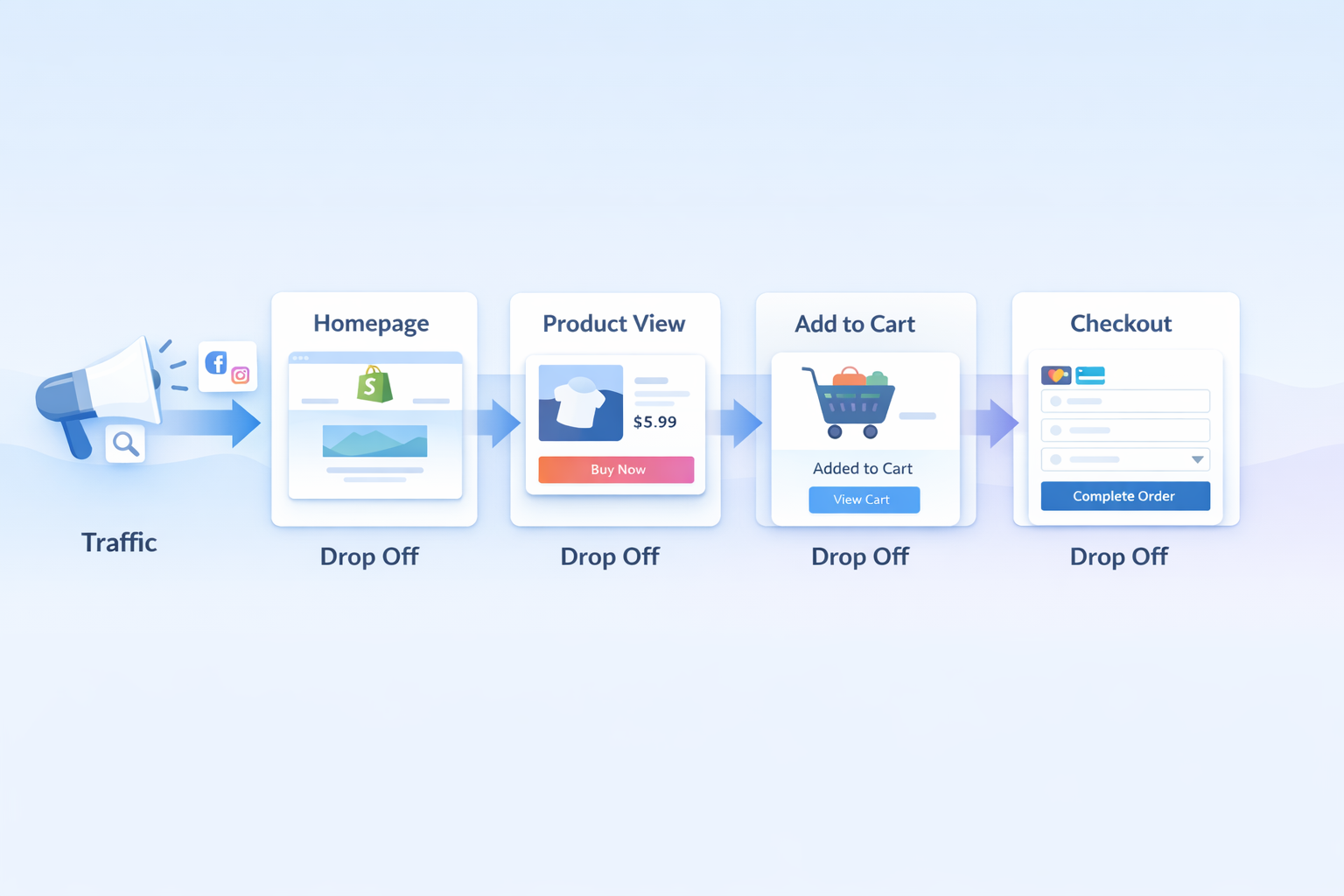
A conversion funnel is simple in theory:
- A visitor lands on your store
- They understand what you sell
- They trust the product
- They trust the brand
- They feel enough urgency or desire
- They complete checkout
But in real stores, people drop off at each stage.
Sometimes the homepage is too vague. Sometimes the product page feels generic. Sometimes there is no proof that real customers love the product. Sometimes checkout introduces friction. Sometimes the store gets traffic, but the traffic is the wrong fit.
That is why “high traffic, low sales” is such a common Shopify problem. Traffic alone is not proof of a healthy store. Conversion rate tells you whether your store is actually persuading the right visitors to take action. Shopify itself frames ecommerce conversion rate as one of the clearest signals of how effectively a store turns interest into action.
The other mistake I see is treating conversion optimization like one isolated fix.
It is not.
It is a chain reaction.
If your homepage creates a weak first impression, fewer people reach product pages with buying intent. If product pages are weak, trust collapses. If checkout feels uncertain, people abandon the cart. If you do not reinforce belief with reviews, videos, FAQs, and trust signals, people delay the purchase.
So when I optimize a Shopify store, I think in layers:
- clarity
- trust
- proof
- momentum
- ease
That is what actually lifts a Shopify conversion rate over time.
What Is a Good Shopify Conversion Rate? (Benchmarks + Reality Check)
A lot of people want a magic number.
They ask: what is a good Shopify conversion rate?](https://www.shopify.com/pk/blog/ecommerce-conversion-rate)
In practice, the answer depends on your product price, traffic quality, niche, device mix, repeat purchase behavior, and how warm your visitors are.
That said, the broad ecommerce benchmark](https://www.dtcpages.com/blog/ecommerce-conversion-rate-benchmarks-2026) most merchants hear is somewhere around 2% to 3%. Shopify’s own recent guidance points to ecommerce conversion rate benchmarks as the standard reference point for judging store performance, while also emphasizing that context matters. Another recent 2026 benchmark analysis based on Shopify store data argues that raw averages can be misleading without industry and funnel context.
So here is how I look at it:
| Conversion Rate | My Read |
|---|---|
| Under 1% | Usually a signal of major trust, targeting, or UX issues |
| 1%–2% | Common for many early or under-optimized stores |
| 2%–3% | Solid baseline for many Shopify stores |
| 3%–5% | Strong store with good traffic-product fit |
| 5%+ | Usually a very well-optimized funnel, strong brand, or warm audience |
I would never use benchmarks to panic.
I use them to diagnose.
If a store is under 1%, I assume something meaningful is broken. If it is sitting between 1.5% and 2.5%, I usually see clear room for improvement through better product messaging, stronger proof, and less friction. If it is already above 3%, then the game becomes more about refinement, segmentation, and raising average order value without hurting conversion.
The bigger point is this:
Do not compare your store blindly to internet averages.
Compare your store against:
- your own past performance
- traffic source performance
- mobile vs desktop performance
- product page vs checkout drop-off
- new visitor vs returning visitor behavior
That is where Shopify conversion optimization becomes useful instead of abstract.
How to Increase Shopify Conversion Rate (Complete Strategy Breakdown)
!increase conversion](/images/increase-shopify-store-conversion/increase-conversion.png)
This is the part I care about most.
Not theory. Not generic advice. Actual fixes.
Optimize Your Shopify Homepage for First Impressions
Your homepage has one job:
Make the right visitor feel instantly understood.
If I land on a homepage and I cannot tell within a few seconds what the brand sells, who it is for, and why I should trust it, the store has already lost momentum.
When I optimize a Shopify homepage, I focus on these things first:
- a clear hero headline
- one obvious CTA
- clean navigation
- instant trust indicators
- visual proof of product value
A homepage should reduce uncertainty, not create it.
!optimize homepage](/images/increase-shopify-store-conversion/optimize-homepage.png)
That means avoiding vague slogans with no product context. It means showing real product use, not just aesthetic lifestyle imagery. It means putting trust badges, shipping info, review snippets, press mentions, or guarantees where they reduce hesitation.
I also like homepage sections that answer buying questions before the visitor has to hunt for them:
- What is this product?
- Why is it better?
- Who is it for?
- What makes this store trustworthy?
- What should I do next?
If the homepage is cluttered, overloaded, or trying to say ten things at once, conversion suffers.
Improve Shopify Product Page Conversion (Most Important Step)
!optimize product page](/images/increase-shopify-store-conversion/optimize-product-page.png)
If I had to pick one page to obsess over, it would be the product page.
That is where purchase decisions are made.
A lot of Shopify product pages do not fail because the product is bad. They fail because the page does not do enough selling.
Here is what I usually improve first:
-
Better product imagery
Your images should answer objections.
Show scale. Show texture. Show angles. Show the product in use. Show what changes for the customer after buying it. -
Benefits before features
Features matter. Benefits convert.
Instead of only saying what the product has, explain what the product does for the buyer.
A feature says: “100% cotton.”
A benefit says: “Soft, breathable fabric that stays comfortable all day.”
-
Clear offer structure
Do not make people decode pricing, shipping, bundles, or variants.
The product page should make the offer feel easy to understand. -
Social proof on-page
Reviews, testimonials, user photos, UGC, and short proof statements remove doubt at the exact moment people hesitate. -
Friction-killing content
This includes FAQs, returns policy highlights, delivery expectations, sizing help, usage notes, and comparison points.
When a Shopify product page is not converting, I usually find one of two issues:
Either the page is visually weak, or the page is not answering the buyer’s internal questions.
Fix that, and conversion usually improves faster than people expect.
Add Social Proof & Trust Signals That Actually Convert
!social proof](/images/increase-shopify-store-conversion/social-proof.png)
Trust signals are not decoration.
They are conversion assets.
When people buy online, especially from a store they have never used before, they are not only evaluating the product. They are evaluating risk.
So I want the store to make them feel safe.
The trust elements I prioritize most are:
- customer reviews
- testimonials with specifics
- user-generated content
- trust badges
- secure payment cues
- shipping and return transparency
- real contact information
- guarantees
The key is not to dump random trust badges everywhere.
The key is relevance.
For example:
- On a homepage, I like review counts, press logos, or guarantee strips
- On a product page, I like review summaries, photo reviews, FAQs, and shipping reassurance
- At checkout or cart, I like security, payment options, and delivery clarity
One thing I have learned: trust is strongest when it feels earned, not manufactured.
That is why customer videos, social proof, and authentic testimonials outperform generic “best quality” claims almost every time.
If you already have customers creating content about your product, use it. Put it where buying decisions happen.
That is one reason embedded content can be so useful inside Shopify pages.
Use Video & Interactive Content (Your Competitive Edge)
!interactive content](/images/increase-shopify-store-conversion/interactive-content.png)
This is where many Shopify stores still leave money on the table.
A static page can explain.
A video can prove.
Interactive content can hold attention longer, reduce doubt faster, and make a product feel more real.
That matters for Shopify conversion optimization because attention and trust are deeply connected. If people engage with your content on-page instead of leaving to check social media, YouTube, or another source, you keep buying momentum inside the store.
This is exactly where I see a tool like EmbedAny becoming genuinely useful.
On the Shopify App Store, EmbedAny is listed as a Built for Shopify app and says it lets merchants embed content anywhere in the store by pasting a link, with support for 800+ services including video, PDFs, social content, and more. Shopify says the Built for Shopify badge means an app has passed its standards for performance, design, and integration.
That matters because one of the biggest frustrations with Shopify embeds is that merchants often end up fighting iframes, HTML limitations, responsiveness, or stripped code. Shopify’s rich text editor does allow HTML in places like product descriptions and pages, but community threads show merchants still run into problems with HTML being sanitized or embed code behaving badly on mobile.

EmbedAny’s positioning is simple: paste a link, turn it into rich interactive content, and avoid relying on fragile iframe workflows. Its site and app listing also emphasize that it works by just pasting a link, with “Ctrl + I” highlighted in the product’s documentation and homepage messaging.
In practical terms, here is how I’d use embedded content to improve Shopify sales:
- embed customer video testimonials on product pages
- add TikTok videos showing real product use
- embed Instagram content as proof of real customers and real use cases
- add product explainer videos next to key objections
- embed comparison charts, guides, or manuals where useful
That is much more persuasive than asking customers to imagine the product from still images alone.
Optimize Shopify Checkout to Reduce Drop-Off
Checkout is where hesitation becomes expensive.
You already paid for the click. You earned the add-to-cart. Then checkout friction kills the sale.
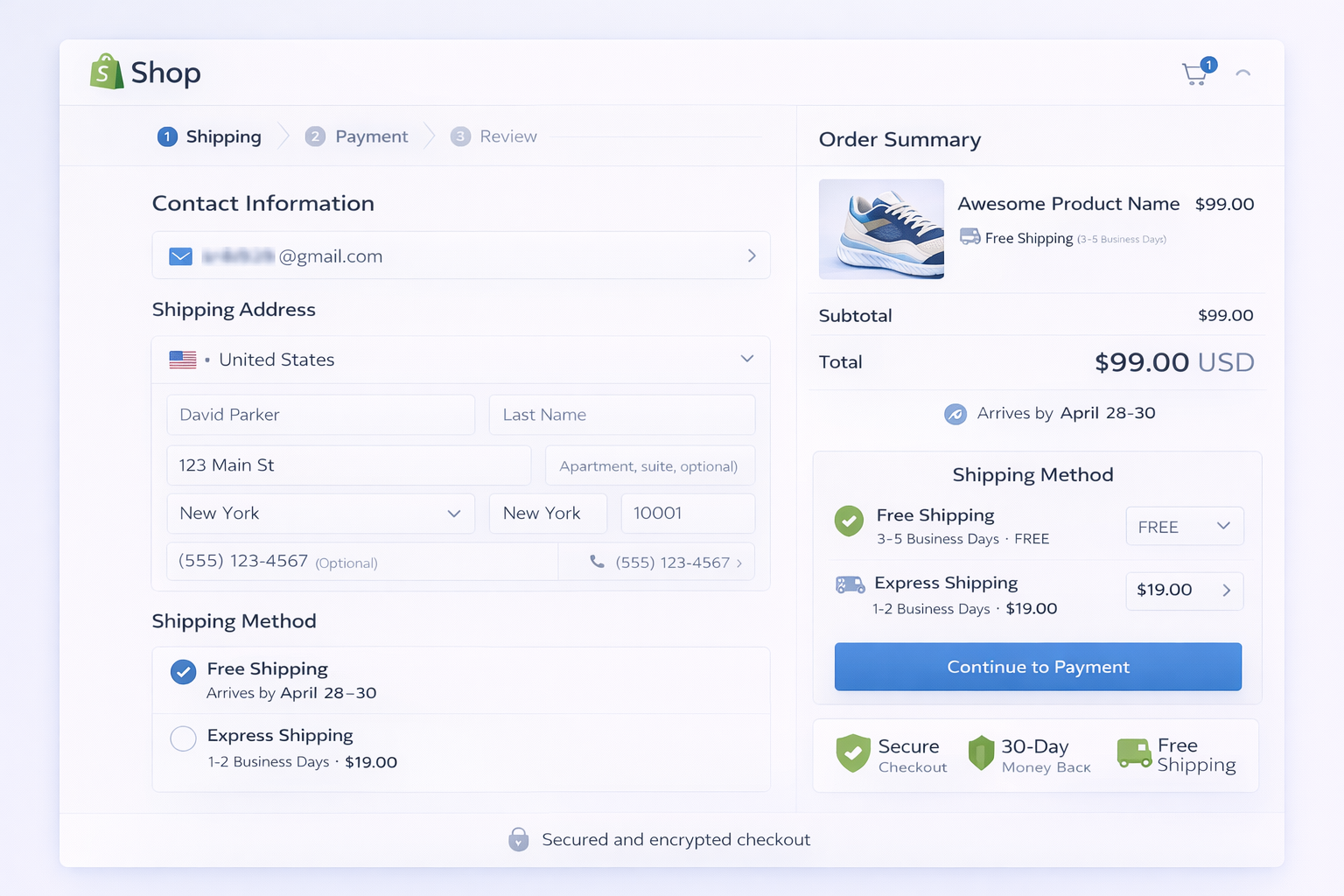
When I look at Shopify checkout drop-off, I usually check these issues first:
- too many steps
- surprise shipping costs
- weak payment flexibility
- missing trust cues
- forced account creation
- unclear delivery times
- distracting cart experience
A good checkout flow feels predictable.
The shopper should know:
- what they are paying
- when they will receive it
- how they can pay
- what happens if something goes wrong
That is why I like:
- express payment options
- visible security and payment trust indicators
- no unnecessary form friction
- honest shipping information
- clear return and support reassurance
If you want to reduce cart abandonment on Shopify, do not only send abandoned cart emails.
Fix the reason people abandoned in the first place.
Use Urgency & Conversion Triggers
Urgency works.
Fake urgency damages trust.
That is the line.
I do use urgency and conversion triggers, but only when they are grounded in reality.
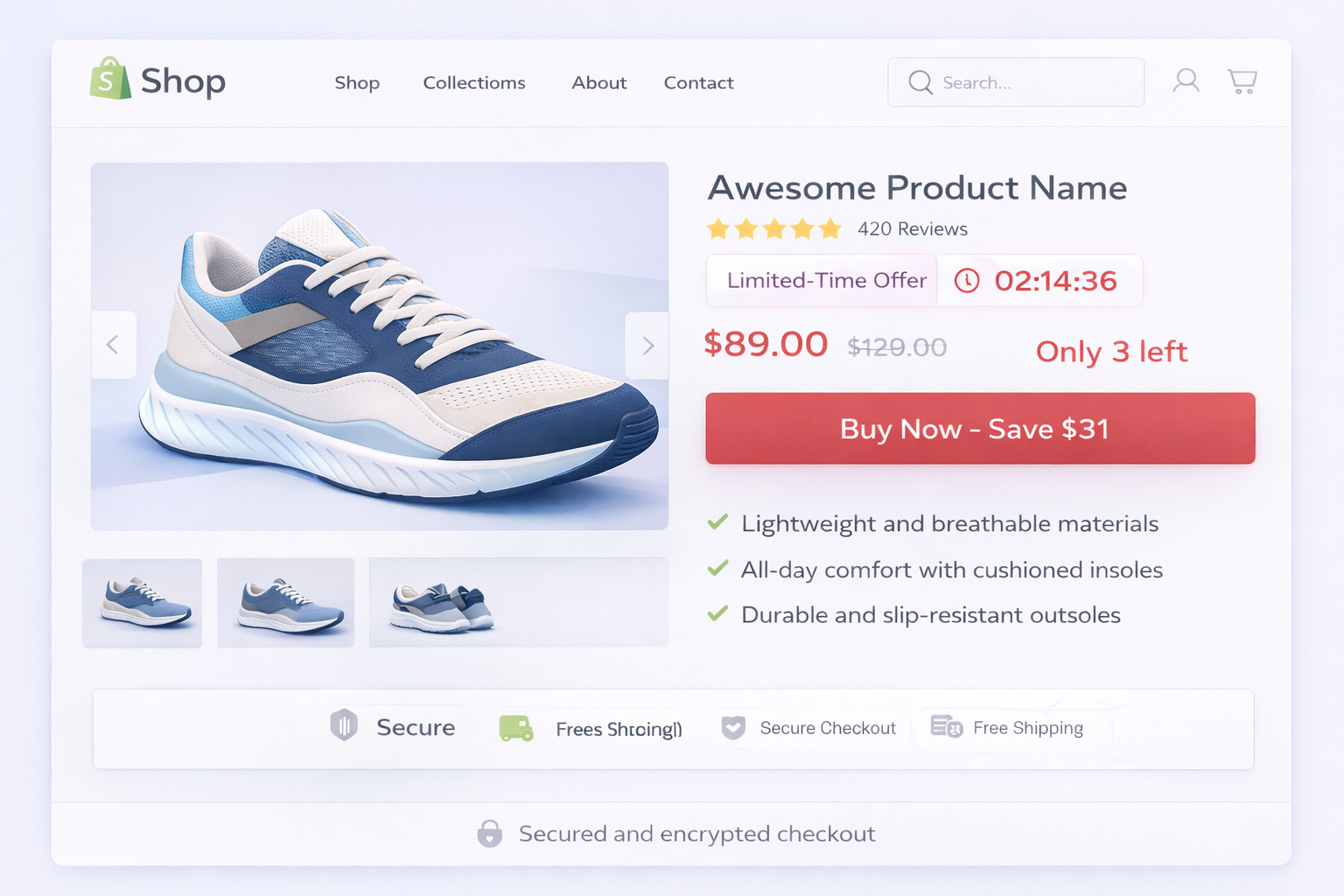
The most effective ones I see are:
- limited-time offers
- low-stock messaging
- shipping deadline cutoffs
- bundle incentives
- real seasonal windows
- countdown timers tied to actual promotions
These work because they reduce procrastination.
But they only work long term if they are credible. If every product is “almost sold out” forever, customers stop believing you.
So my rule is simple:
Use urgency to clarify timing, not manipulate people.
That improves conversion without weakening brand trust.
Shopify Conversion Strategies That Instantly Improve Sales
Some Shopify conversion strategies take time.
Some are quick wins.
Here are the improvements I often make first when I need faster impact:
- tighten homepage messaging
- rewrite product page headlines and first-screen copy
- improve product media
- add visible trust signals above the fold
- shorten or simplify product descriptions
- add FAQ sections to reduce hesitation
- improve CTA clarity
- remove distracting layout clutter
- speed up page loading by cutting unnecessary weight
- add video or social proof to top-selling products
If a store is getting traffic but not enough sales, these are the first levers I test.
They are not glamorous.
They work.
Best Shopify Apps for Conversion Rate Optimization
I do not believe in installing a dozen apps and hoping conversion improves.
That usually creates more clutter than clarity.
I prefer a small stack where each app solves one meaningful problem.
The categories I usually care about are:
| App Type | What It Helps With |
|---|---|
| Reviews / social proof | Builds credibility |
| Upsell / bundles | Raises AOV |
| Email / SMS recovery | Recovers lost carts |
| Heatmaps / analytics | Shows behavior friction |
| Speed / performance tools | Reduces drop-off |
| Content embedding tools | Adds persuasive proof on-page |
For the last category, EmbedAny stands out because it is not trying to be a full page builder. It is positioned as a lightweight way to add external content to Shopify by pasting a link, rather than relying on iframe-heavy workflows or multiple single-purpose widget apps. The Shopify App Store listing says it supports unlimited links on its listed plan and no-code embedding across 800+ services.
So when I think about the best Shopify apps for conversion rate optimization, I would not put EmbedAny in the “generic design” bucket.
I would put it in the “proof and content enhancement” bucket.
That is useful when your store needs richer product pages, stronger social proof, and more persuasive content without forcing shoppers off-site.
Common Shopify Conversion Mistakes to Avoid
Some mistakes show up again and again.
If I see these on a store, I already know conversion is probably being held back:
-
Cluttered design
Too many banners, too many colors, too many competing calls to action. -
Weak first impression
The homepage does not explain what the brand sells or why it matters. -
Poor product descriptions
They are vague, generic, or feature-heavy with no emotional payoff. -
No trust signals
No reviews, no testimonials, no guarantees, no reassurance. -
No real proof
The store claims quality but does not show it through content, UGC, or customer feedback. -
Friction-heavy checkout
Unexpected costs, limited payment methods, weak clarity. -
Relying only on static content
No video, no interactive proof, no richer product storytelling. -
Treating conversion as one fix
It is not one tweak. It is a system.
Final Thoughts: How I Approach Shopify Conversion Optimization
When I optimize a Shopify store, I do not chase “hacks.”
I look for buying friction.
Then I remove it.
That usually means:
- making the homepage clearer
- making product pages more persuasive
- adding stronger trust signals
- using better proof
- embedding richer content where it helps
- simplifying checkout
- creating honest urgency
That is how I approach Shopify conversion rate optimization in the real world.
And if I am working on a store that needs better proof on the page, I will absolutely look at tools that make it easier to add videos, social content, and interactive assets without creating a technical mess. That is where EmbedAny makes sense to me: not as a gimmick, but as a simple way to bring higher-converting content into Shopify pages using links instead of brittle embed workflows. Its positioning around paste-a-link embeds, broad platform support, and Built for Shopify status makes that a reasonable fit for conversion-focused stores.
If your Shopify store is not converting, I would not start by redesigning everything.
I would start by asking:
- Where does trust break?
- Where does clarity weaken?
- Where does buying momentum slow down?
Fix those, and conversion usually starts moving in the right direction.
FAQs
what is a good shopify conversion rate
A good Shopify conversion rate depends on your niche and traffic quality, but many merchants use the 2% to 3% range as a practical benchmark. Strong stores often outperform that, especially with better product pages and warmer traffic.
how do i increase conversion rate on shopify
I increase Shopify conversion rate by improving homepage clarity, strengthening product pages, adding trust signals, using better social proof, reducing checkout friction, and embedding richer proof content like videos and testimonials.
what affects conversion rate in ecommerce
Conversion rate is affected by traffic quality, pricing, offer clarity, page UX, trust, proof, shipping expectations, checkout experience, and site speed.
how can i improve my shopify store performance
Start with clearer messaging, faster pages, cleaner design, stronger product media, better CTAs, and fewer friction points in checkout. Also audit apps so your store is not carrying unnecessary weight.
what makes a shopify store successful
A successful Shopify store matches the right product with the right audience and presents it clearly, credibly, and persuasively. Strong stores reduce doubt at every stage.
how to optimize product page for conversions
Use better images, benefit-led copy, review content, FAQs, shipping clarity, stronger CTAs, and richer on-page proof such as videos or customer content.
how to increase trust in ecommerce store
Add reviews, testimonials, guarantees, secure payment cues, transparent shipping and return policies, real contact information, and authentic user-generated content.
what elements increase online sales
The biggest elements are clarity, trust, social proof, urgency, product education, easy checkout, and lower friction across the whole funnel.